
In the fiercely competitive world of beverage retail, serving a delicious cup of milk tea is only half the battle. The true engine of a successful business lies in the financial architecture behind that cup. As a global owner or investor, understanding the nuances of bubble tea pricing is the difference between a thriving franchise and a shop that barely breaks even. Many entrepreneurs make the fatal mistake of simply copying their competitors’ prices without understanding their own cost structures. This approach is dangerous because your competitor might have lower rent, better supply chain contracts, or different overheads.
At Mustea, we believe that data-driven decisions are the bedrock of sustainability. We do not just supply premium tea leaves and toppings; we empower our partners with the knowledge to price them correctly. This comprehensive guide will take you through the anatomy of a profitable price point. We will dissect the Cost of Goods Sold, labor, overhead, and the psychological aspects of menu engineering. By mastering these elements, you can set a bubble tea pricing strategy that ensures healthy margins while remaining attractive to your local market.

Chapter 1 Deconstructing the Cost of Goods Sold
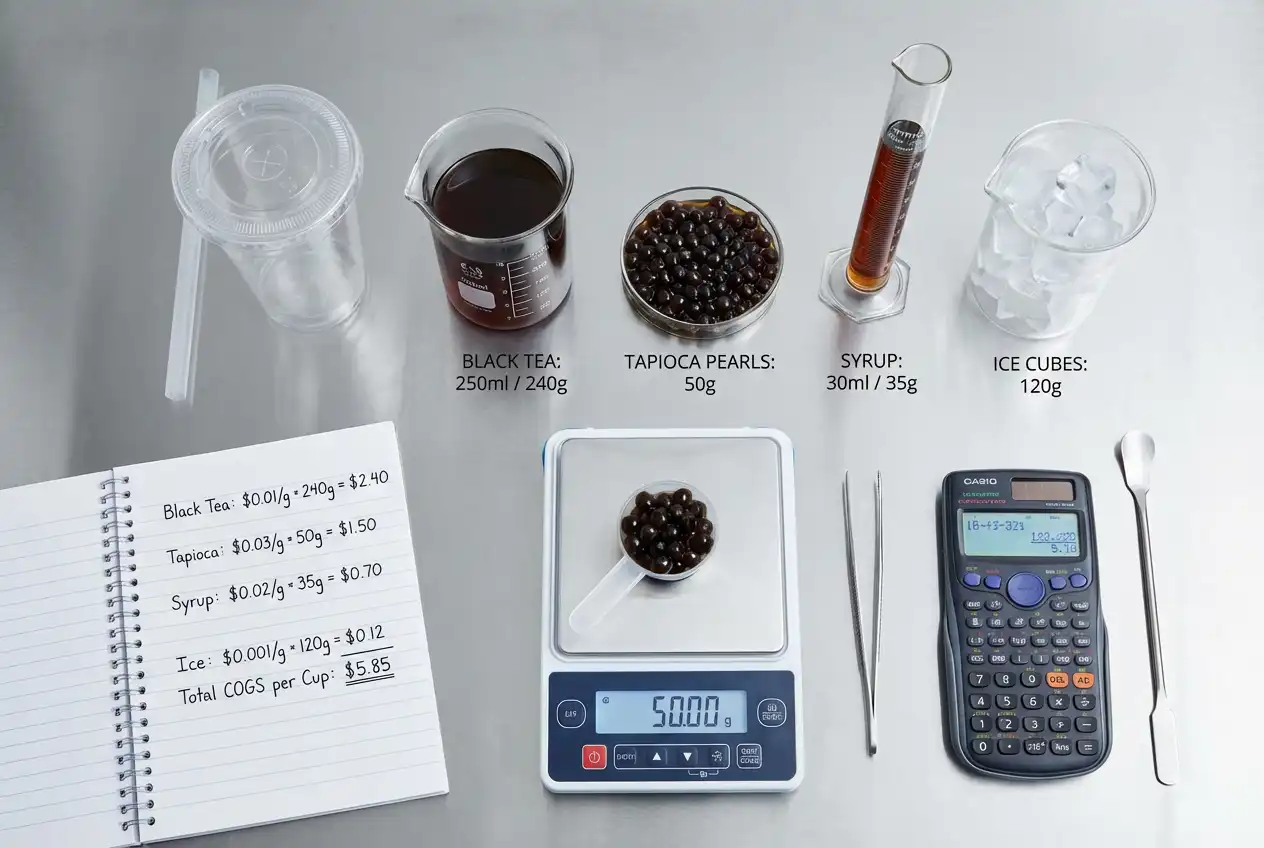
To set the right price, you must first know exactly what one cup costs you to make. This is known as the Cost of Goods Sold or COGS. In the bubble tea industry, COGS is relatively easy to calculate but often underestimated due to hidden wastage. A standard cup of pearl milk tea consists of tea liquid, creamer or milk, sugar or fructose, tapioca pearls, water, ice, the cup, the sealing film or lid, and the straw.
Calculating the Micro-Costs
You must break down costs to the gram. For example, if a bag of Mustea Premium Assam Black Tea costs $15 and yields 40 liters of tea base, you must calculate the exact cost of the 200ml used in a 500ml cup. Similarly, tapioca pearls have a yield rate; 1kg of dry pearls might produce 2.2kg of cooked pearls. You need to know the cost of the cooked scoop, not just the dry weight.
When we consult with clients, we often find they forget to include the “consumables” in their bubble tea pricing models. The cup, the custom logo film, and the straw can add up to $0.15 to $0.20 USD per serving. If your selling price is $5.00, that $0.20 represents 4% of your revenue. Ignoring this can skew your profit margin calculations significantly.
The Impact of Quality on COGS
There is a misconception that lowering COGS by buying cheaper ingredients is the best way to increase profit. This is a short-term strategy that damages long-term growth. Using cheap, artificial-tasting tea or hard boba will drive customers away. The goal of effective bubble tea pricing is to find the sweet spot where you use high-quality ingredients—like Mustea’s authentic Taiwanese tea—that justify a higher retail price. Customers are willing to pay a premium for quality. Therefore, your COGS might be higher, but your margin dollars will also be higher because you can command a better market price.
Chapter 2 Factor in Labor and Overhead Expenses
While COGS covers the tangible product, your bubble tea pricing must also cover the invisible costs of doing business. Rent, utilities, insurance, and labor are fixed and variable costs that must be absorbed by every cup sold.
Labor Cost Per Cup
Labor is often the second largest expense after rent. To calculate labor cost per cup for your bubble tea pricing model, you need to estimate your throughput. If you pay a staff member $15 per hour and they can make 30 drinks an hour efficiently, the direct labor cost is $0.50 per cup. However, during slow hours, they might only make 5 drinks, raising the labor cost to $3.00 per cup for that hour. A weighted average is necessary. Efficient workflow design, which Mustea helps clients achieve, maximizes staff output, thereby lowering the labor cost per unit and allowing for more competitive pricing.
Overhead Allocation
Rent, electricity (especially for ice machines and fridges), and marketing budgets are overheads. If your total monthly overhead is $5,000 and you sell 5,000 cups a month, you need to add $1.00 to the cost of every cup just to break even on overhead. This simple math highlights the importance of volume. The more you sell, the lower the overhead cost per cup becomes. Your bubble tea pricing must be set high enough to cover these costs during average sales volume, not just best-case scenarios.
Alt Text: Precision measurement is key to accurate bubble tea pricing and consistency.
Description: A close-up shot of a barista’s hands pouring fresh milk into a cup resting on a digital scale, emphasizing the precision required for cost control and recipe consistency.
Chapter 3 The Psychology of Menu Engineering
Once you know your floor price (the break-even point), you can determine your ceiling price based on market psychology. Menu engineering is the art of designing your menu to influence customer spending.
The Decoy Effect and Sizing
Never offer just one size. By offering Regular and Large (or Medium and Large), you can use the “decoy effect.” If a Regular is $5.00 and a Large is $6.00, the customer perceives the Large as a better value because for only $1 more, they get 30% more product. However, the cost of the extra tea and water to you is negligible, perhaps $0.10. This upsize is pure profit. Effective bubble tea pricing strategies always push customers toward the larger, higher-margin sizes.
Premium Toppings and Modifications
The base drink is just the entry point. The real profit often lies in the toppings. Charging $0.75 for a scoop of pudding or aloe vera that costs you $0.10 is a massive margin booster. Your menu should encourage customization. Highlight “Must Try” combinations or “Top Sellers” that include multiple toppings. This increases the average ticket size without raising the base price of the tea, keeping your brand perceived as affordable while maximizing revenue per customer.

Chapter 4 Waste Management and Hidden Losses
Waste is the silent killer of profit. In the food and beverage industry, if you do not measure waste, you cannot manage it. Your bubble tea pricing must account for a certain percentage of unavoidable waste, usually 3% to 5%.
The Shelf Life of Tapioca
Cooked tapioca pearls have a short optimal lifespan, typically 4 to 6 hours. After that, they lose their chewy texture and must be discarded. If you cook too much in the morning and throw half away, your actual COGS for boba doubles. Smart inventory management and batch cooking are essential. Mustea advises clients on how to forecast demand to minimize this waste.
Tea Oxidation
Similarly, brewed tea oxidizes over time, becoming bitter or sour. Premium tea shops discard tea bases every 4 to 6 hours. While this ensures quality, it is a cost. If you fail to account for these dumped liters in your bubble tea pricing, your calculated margins will be inaccurate. Staff training is critical here; accurate forecasting and disciplined brewing schedules save money.
Chapter 5 Dynamic Pricing and Promotions
A static price list is not always the best strategy. Markets fluctuate, and so should your tactics.
Promotional Discounts
“Buy One Get One Free” is a classic, but be careful. It essentially halves your revenue while keeping COGS the same (or doubling COGS for the same revenue). Instead, consider “Buy One Get One 50% Off” or bundle deals like “Tea plus Snack.” These maintain better margins. Your bubble tea pricing structure should have enough buffer to absorb these marketing costs without putting you in the red.
Seasonal Adjustments
Ingredients like fresh fruits fluctuate in price. A strawberry tea might cost $1.50 to make in summer but $2.50 in winter. You can use seasonal pricing or “Market Price” designations, or simply average the cost over the year. However, being transparent with customers about why a premium seasonal item costs more usually builds trust rather than resentment.
Chapter 6 Comprehensive Cost Breakdown Example
To visualize how these elements come together, let us look at a hypothetical breakdown for a standard 500ml Brown Sugar Pearl Milk Tea sold in a Western market.
| Item Component | Est. Cost (USD) | Notes |
| Tea Base (200ml) | $0.08 | Premium Mustea Black Tea |
| Milk / Creamer (150ml) | $0.25 | Fresh milk or non-dairy creamer |
| Tapioca Pearls (1 scoop) | $0.12 | Including cooking energy/water |
| Brown Sugar Syrup (30ml) | $0.10 | High viscosity syrup |
| Cup, Lid/Film, Straw | $0.18 | Custom branded packaging |
| Total Material Cost (COGS) | **$0.73** | |
| Labor & Overhead (Allocated) | $1.50 | Rent, Staff, Utilities |
| Total Cost to Produce | **$2.23** | |
| Retail Selling Price | $5.50 | Market average |
| Net Profit Per Cup | $3.27 | |
| Net Profit Margin | 59% |
Chapter 7 Strategic Sourcing with Mustea
The most direct way to improve your margins without raising prices is to lower your COGS through strategic sourcing. This is where Mustea steps in as your partner.
We provide economies of scale. By purchasing your tea, powders, and toppings from a single integrated supplier, you save on shipping and logistics. Consolidating orders reduces the landed cost of your goods. Furthermore, our R&D team helps you develop recipes that use cost-effective ingredients to achieve premium flavors. We teach you how to use concentrated syrups effectively so you use less volume per cup without sacrificing taste.
Your bubble tea pricing strategy is only as strong as your supply chain. If your supplier has fluctuating prices or inconsistent quality, your margins will be unstable. Mustea offers stability, allowing you to price with confidence and focus on growing your brand.
FAQ
Q1 How do I determine the best selling price for my area?
You must conduct a competitor analysis. Check the prices of the top 3 competitors in your radius. Your bubble tea pricing should be comparable if you offer similar quality, or higher if you offer a distinctly premium product with better branding and ingredients.
Q2 What is a healthy food cost percentage for a bubble tea shop?
Ideally, your food cost (COGS) should be between 20% and 30% of your selling price. If it exceeds 35%, your margins will be too tight to cover rent and labor comfortably.
Q3 Should I charge extra for plant-based milk?
Yes. Oat milk, almond milk, and soy milk are significantly more expensive than cow’s milk or creamer. It is standard industry practice to add a surcharge (e.g., +$0.50) to cover this difference in your bubble tea pricing.
Q4 How often should I raise my prices?
You should review your prices annually or whenever there is a significant jump in ingredient costs. Small, incremental increases (e.g., $0.25) are better received by customers than sudden large jumps.
Q5 How does ice level affect my cost?
Ice is the cheapest ingredient. Customers requesting “No Ice” effectively ask for more tea or milk to fill the cup, which increases your COGS. Some shops charge extra for “No Ice,” while others factor this variance into the average price.
Q6 Can I use cheaper ingredients to lower prices?
We strongly advise against this. In the long run, quality wins. Using cheap powder instead of real tea might save pennies, but it will lose you repeat customers. Better bubble tea pricing comes from efficiency, not compromising quality.
Q7 How do I calculate the cost of a new menu item?
Start with the recipe. Weigh every ingredient in grams. Multiply the weight by the cost per gram. Add the packaging cost. Then divide this total COGS by your target food cost percentage (e.g., 0.25) to get a suggested selling price.
Q8 What is the “Golden Ratio” for profit?
A common rule of thumb in the industry is 30-30-20-20. 30% COGS, 30% Labor, 20% Overhead, and 20% Net Profit. Adjust your bubble tea pricing to aim for this distribution.
Q9 How can Mustea help me with pricing?
Mustea provides detailed product yield charts. We can tell you exactly how many cups you can get from a case of syrup or a bag of tea, helping you calculate your exact cost per cup to the penny.
Q10 Should I include tax in the menu price?
This depends on local laws and customs. In the US, tax is usually added at the register. In Asia and Europe (VAT), tax is often included in the displayed price. Ensure your bubble tea pricing strategy aligns with local expectations.
Summary
Setting the right price is a delicate balance between art and science. It requires a deep understanding of your tangible costs (ingredients, packaging) and your intangible costs (labor, rent, brand value). Effective bubble tea pricing is not about being the cheapest on the block; it is about delivering value that customers are happy to pay for while securing a healthy margin for your business survival.
By controlling your COGS, managing waste, and utilizing psychological menu engineering, you can maximize your profitability. Remember, you do not have to do this alone. Mustea is here to provide not just the raw materials, but the business intelligence you need to succeed. From yield analysis to supply chain optimization, we are your partner in profit.
Are you ready to optimize your menu for maximum profitability? Contact Mustea today for a consultation on ingredient selection and cost analysis strategies tailored to your market.

