

Investing in the bubble tea industry is often presented as a golden ticket. Stories of long queues and rapid expansion dominate the headlines. However, for the serious entrepreneur or institutional investor, the glamour of social media takes a back seat to the hard numbers of financial performance. The most critical question you must answer before signing a lease is not about the flavor of the tea, but about the Return on Investment. Specifically, you need to know your Tea Shop ROI and exactly when you will reach the break even point.
As Mustea, your strategic partner in the global tea business, we believe in transparency. We have seen shops open with great fanfare only to close within a year because they failed to understand their cash flow dynamics. Conversely, we have supported partners who meticulously planned their financials and achieved full payback in under 12 months. This guide is designed to demystify the financial metrics of the industry. We will move beyond simple profit margins and dive deep into the timeline of recovery, helping you build a business model that is as robust as it is profitable.
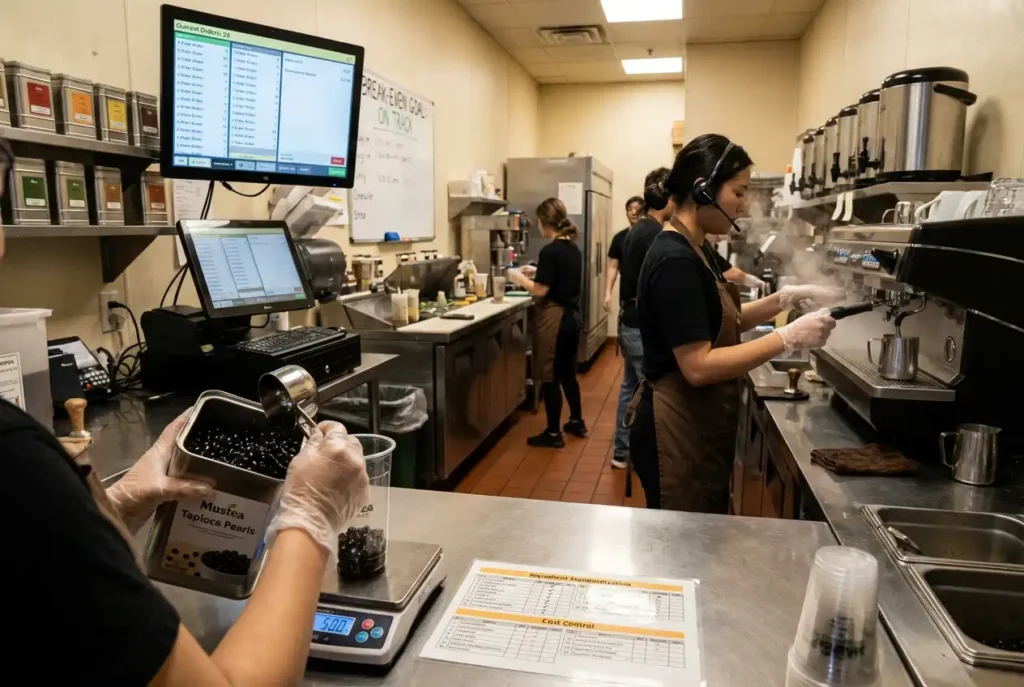
Chapter 1 Defining Tea Shop ROI and Break Even Analysis
To manage your expectations, we must first define the terms. ROI, or Return on Investment, is a performance measure used to evaluate the efficiency of an investment. In the context of a bubble tea store, it is calculated by dividing the net profit by the total initial capital investment. However, before you see a return, you must hit the break even point. This is the moment when your total revenue equals your total costs. At this exact point, you have not made money, but you have stopped losing it.
The Formula for Break Even The break even point is usually calculated in terms of the number of cups you need to sell. The formula is: Break Even Volume = Total Fixed Costs / (Average Selling Price per Cup – Average Variable Cost per Cup)
Understanding this formula is the first step to financial freedom. The denominator (Price minus Variable Cost) is known as the Contribution Margin. This is the amount of money from each cup that contributes to paying off your fixed costs like rent and salaries. As a supplier, Mustea plays a direct role here. By offering competitive wholesale prices on high-quality tea and toppings, we lower your variable costs, thereby increasing your contribution margin and lowering the number of cups you need to sell to break even.
Chapter 2 Calculating Your Total Initial Investment
You cannot calculate Tea Shop ROI if you do not know your total “I” (Investment). This goes beyond just the renovation and equipment costs we discussed in previous articles. It includes the “working capital” required to keep the business afloat before it becomes profitable.
Sunk Costs vs Working Capital Sunk costs are one-time expenses: the espresso machine, the sealing machine, the interior design, and the franchise fee if applicable. Working capital is the cash reserve you need for inventory replenishment, staff wages, and utilities during the first few months when sales might be slow. Many businesses fail because they run out of cash just before they hit their break even point. We recommend having at least 6 months of operating expenses in liquid cash. This buffer ensures that you can weather the storm of a slow launch or unexpected global events without compromising on product quality.
Chapter 3 Analyzing Variable Costs and Contribution Margins
Your variable costs are the costs that change directly with sales volume. In a tea shop, this is primarily your Cost of Goods Sold (COGS), packaging, and direct labor hours that are flexed based on demand.
The Impact of Ingredients If your average ticket price is $6.00 and your ingredients (tea, milk, boba, cup) cost $1.50, your contribution margin is $4.50. This $4.50 is what you have left to pay the landlord. If you choose a cheaper supplier and lower your cost to $1.20, your margin becomes $4.80. While 30 cents seems small, over 10,000 cups a month, that is $3,000 in pure additional profit. However, this is where the “Mustea Philosophy” is crucial. Lowering costs by sacrificing quality reduces customer retention. If your tea lacks the distinct “mountain flavor” of authentic Taiwanese Oolong, customers will not return. A lower repeat purchase rate increases your marketing costs (Customer Acquisition Cost), which hurts your Tea Shop ROI in the long run. The goal is to optimize costs through efficient supply chain management, not by buying inferior product.
Chapter 4 Fixed Costs and the Volume Game
Fixed costs are the expenses you pay regardless of whether you sell one cup or one thousand. These include rent, insurance, salaried manager wages, internet, and equipment depreciation.
Rent to Revenue Ratio A healthy tea shop should aim for rent to be no more than 10% to 15% of gross revenue. If your rent is $5,000 per month, you need to generate roughly $50,000 in sales to be in a safe zone. If your average cup is $6, you need to sell about 8,333 cups a month, or roughly 277 cups a day. When you are selecting a location, this math is vital. A high-footfall location with $10,000 rent might seem expensive, but if it guarantees 600 cups a day, the Tea Shop ROI will be faster than a cheap location with $2,000 rent that only sells 50 cups a day. Do not fear high rent; fear low volume.
Chapter 5 Realistic Timelines for Payback
So, how long does it actually take? This is the most common question we receive at Mustea. While every market is different, we can offer general benchmarks based on our global client data.
The 12 to 24 Month Window For an independent store with a solid product and good location, the typical break even on the initial investment (payback period) is between 12 and 24 months. Months 1-3: Usually operating at a loss or just covering operating costs due to high marketing spend and staff training inefficiencies. Months 4-6: Growth phase. Customer base stabilizes. You start generating positive monthly cash flow. Months 7-12: Optimization phase. Costs are controlled, sales are steady. You are now paying back the initial capital. Year 2: Pure profit generation.
Factors That Speed Up ROI
- High Average Ticket Size: Selling snacks or combo deals increases revenue without increasing the customer count.
- Low Waste: Efficient kitchen operations reduce COGS.
- Strong Supply Chain: Buying direct from Mustea removes the middleman markup on ingredients.
- Corporate Catering: Bulk orders for offices provide massive revenue spikes with low labor cost.

Chapter 6 Customer Lifetime Value CLV and Long Term ROI
Investors often focus too much on the first sale. The real secret to a massive Tea Shop ROI is the Customer Lifetime Value. A customer who buys a $6 drink once is worth $6. A customer who loves your product and buys a $6 drink twice a week for a year is worth $624. To achieve this, product consistency is non-negotiable. If a customer visits your shop and the tapioca is too hard or the tea is too bitter because of poor supply, you lose that $624 forever. High-quality raw materials are an investment in CLV. When you use Mustea’s premium tea leaves, you are effectively buying an insurance policy for customer loyalty. The slight increase in cost per cup is insignificant compared to the value of a loyal regular.
Chapter 7 The Exit Strategy
ROI is not just about monthly cash flow; it is also about the asset value. A profitable tea shop is a sellable asset. If you build a brand with strong operational systems and a loyal customer base, you can eventually sell the business for a multiple of its annual earnings (usually 2x to 3x). Including this potential exit value in your calculation makes the Tea Shop ROI even more attractive. However, this is only possible if your supply chain is transferable and your quality is standardized. Using a reputable supplier like Mustea ensures that your recipes and supply lines are professional and documented, adding value to your business in the eyes of a potential buyer.
Chapter 8 Strategies to Improve Your Numbers
If your calculated break even point looks too far away, there are levers you can pull.
Menu Engineering Analyze your sales mix. Which drinks have the highest contribution margin? Usually, fruit teas using syrups and water have better margins than milk teas using fresh dairy. Promote these high-margin items on your menu boards and digital screens.
Operational Efficiency Labor is a huge variable. Use technology like self-ordering kiosks (which we discussed in the Cost guide) to reduce front-of-house labor. Ensure your kitchen layout minimizes steps. Every second saved per drink adds up to labor hours saved per week.
Strategic Sourcing Review your supplier contracts. Are you paying too much for shipping? Are you buying small bags when you should be buying bulk? Mustea offers volume discounts and logistics consolidation that can shave percentage points off your COGS, directly accelerating your Tea Shop ROI.
FAQ
Q1 What is a good ROI for a bubble tea shop? A generic benchmark for a successful store is 20% to 30% cash-on-cash return annually after the business stabilizes. This outperforms most stock market investments.
Q2 How many cups do I need to sell to break even daily? This depends entirely on your rent and costs, but for a standard shop, the daily break even volume usually lies between 150 and 250 cups.
Q3 Why is my profit margin lower than expected? Common culprits are hidden waste (throwing away tea/boba), overstaffing during slow hours, or theft. Regular audits and inventory tracking are essential.
Q4 Does franchising affect my ROI? Yes. Franchising involves royalty fees (usually 4-6% of gross sales) and marketing fees. This lowers your monthly profit margin, extending your payback period, but it lowers the risk of failure.
Q5 How does seasonality affect the break even point? Beverage sales are often seasonal. Summer sales can be 30% higher than winter sales. You must calculate your break even based on a yearly average, not just your peak summer months.
Q6 Can I improve ROI by increasing prices? Yes, but be careful. If you raise prices without improving quality or experience, you may lose volume. Price increases should be justified by premium ingredients or new branding.
Q7 What is the biggest risk to my ROI? The biggest risk is a poor location followed closely by poor product quality. You can fix a bad menu, but you cannot fix a bad location or a ruined reputation from bad drinks.
Q8 How can Mustea help me reach break even faster? We provide “Starter Kits” and optimized equipment lists that prevent you from overspending on startup capital. We also offer high-margin recipes to ensure your menu is profitable from day one.
Q9 Should I buy the building or lease it? Leasing is better for ROI in the short term as it requires less upfront capital. Buying real estate changes the business model from a tea shop to a property investment.
Q10 Is the bubble tea market saturated? While some areas are crowded, the global demand is still growing. The market is consolidating towards quality. Shops with poor ROI are closing, making room for professional, high-quality brands to take market share.
Summary
Understanding Tea Shop ROI is the difference between gambling and investing. The path to profitability is governed by a simple equation: maximize sales volume while minimizing variable costs and controlling fixed overheads. The break even point is the milestone you must focus on with laser intensity during your first year. It requires discipline, data, and the right partners. By choosing Mustea, you are not just buying ingredients; you are aligning your business with a supply chain expert dedicated to improving your margins. We help you control the variables so you can predict the result. Your return on investment is our priority.
Are you ready to build a business model that works? Contact Mustea today for a profitability consultation and let us help you calculate the numbers for your specific market.

