In the world of B2B procurement, few acronyms cause as much friction and confusion as MOQ. It stands for Minimum Order Quantity. For a new bubble tea shop entrepreneur enthusiastic about launching their brand, encountering a supplier requirement to purchase 500 kilograms of tapioca pearls or 100 kilograms of loose leaf tea can feel like a massive barrier to entry. It often leads to the question Why can I not just buy five bags to start?
However, for a professional supplier like Mustea, Wholesale MOQ is not an arbitrary number invented to make life difficult for buyers. It is a fundamental economic necessity that sustains the manufacturing and logistical ecosystem. Without MOQs, the wholesale pricing structure would collapse, and the cost per cup for your business would skyrocket. Understanding the logic behind Wholesale MOQ is the first step in maturing from a hobbyist shop into a scalable franchise. In this article, we will pull back the curtain on factory operations and logistics to explain why these minimums exist and how they actually protect your profit margins in the long run.

Chapter 1 The Production Reality Efficiency and Waste
To understand Wholesale MOQ, you must first understand the factory floor. Manufacturing food products is not like printing a document; it involves complex setup processes.
Imagine the production of our signature Strawberry Syrup. Before the first bottle is filled, the production line must be cleaned and sterilized (CIP – Clean In Place). The mixing tanks must be calibrated. The ingredients must be weighed and loaded. This setup process takes time and labor, regardless of whether we produce 10 bottles or 10,000 bottles. If we run the machine for just 100 bottles, the cost of the setup labor and the “start-up waste” (the initial product that runs through the pipes to prime the system) is distributed across only those 100 units. This makes the unit cost astronomically high. By enforcing a Wholesale MOQ, we ensure that the machine runs long enough to amortize these setup costs across thousands of units, driving the price down to a level that allows you to make a profit.
Chapter 2 The Customization Factor OEM vs Standard Stock
The level of MOQ depends heavily on whether you are buying “Standard Stock” or “Custom OEM” products.
Standard Stock
For items that Mustea keeps in our warehouse regularly, like our Classic Assam Black Tea or standard 8.5mm Tapioca Pearls, the Wholesale MOQ is lower. We have already produced these in bulk. Here, the MOQ is dictated by “Case Pack” or “Pallet” efficiency. We might require a minimum of 1 carton (20 bags) simply because breaking a carton is inefficient for our warehouse staff and increases the risk of shipping damage.
Custom OEM
If you want a custom tea blend or a printed cup with your logo, the MOQ rises significantly. For printed cups, the factory must make a printing plate cylinder. The setup for the printing press takes hours. Therefore, the industry standard MOQ for custom cups is often 30,000 to 50,000 pieces. It is physically impossible to print 500 cups without charging $5.00 per cup, which no business model can support.
Chapter 3 Logistics and Shipping Economics
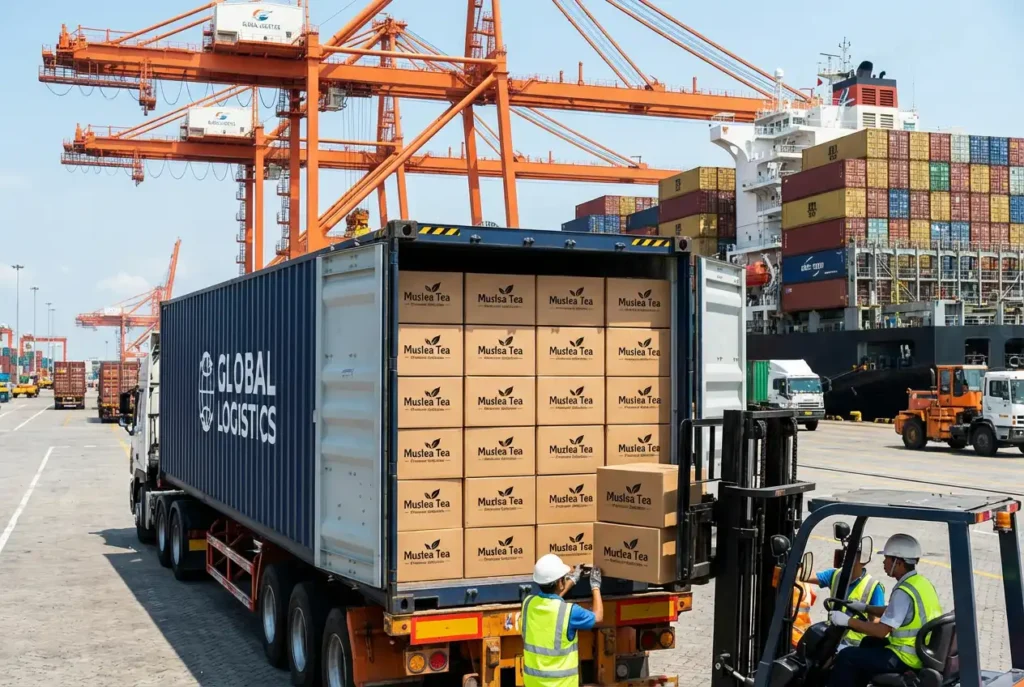
For international buyers, logistics is often the primary driver of Wholesale MOQ. Shipping air freight is fast but costs $5 to $10 per kilogram. Sea freight is slow but costs pennies per kilogram. However, sea freight works on volume.
The LCL Trap
Less than Container Load (LCL) allows you to ship a few pallets. However, the port fees, documentation fees, and customs clearance fees are fixed. Whether you import 1 pallet or 10 pallets, the paperwork cost is roughly the same. If you import a tiny volume, these fixed fees eat up your margin. Mustea advises a Wholesale MOQ that optimizes the shipping cost per unit. Usually, reaching a minimum of 1 to 2 pallets (approx. 1000kg) creates the “tipping point” where international import becomes cheaper than buying from a local distributor.
Pallet Integrity
Shipping loose boxes is a recipe for disaster. Boxes get crushed, wet, or lost. Shipping a wrapped, strapped pallet ensures your goods arrive intact. Therefore, our MOQ is often aligned with “Full Layer” or “Full Pallet” quantities to ensure structural integrity during the month-long ocean voyage.
Chapter 4 The Tiered Pricing Structure
MOQ is directly linked to price. In B2B, there is never just one price. There is a tiered pricing structure. Tier 1 (Sample/Trial): No MOQ, but highest price (Retail + Handling). Tier 2 (Wholesale Standard): Standard MOQ (e.g., 5 cartons), wholesale price. Tier 3 (Distributor/Container): High MOQ (e.g., 20ft Container), lowest factory price.
By committing to a higher Wholesale MOQ, you unlock Tier 3 pricing. This gives you a competitive advantage against rival shops in your city. If you can buy your boba at $30 per case while your competitor buys at $45 per case because they buy small volumes, you can either undercut their prices or enjoy much healthier profit margins.
Chapter 5 Inventory Management The Balancing Act
The fear of MOQ is often a fear of “Overstock.” Owners worry about cash flow being tied up in inventory or products expiring.
Safety Stock
However, running “Just in Time” inventory is dangerous in the current global climate. Port strikes, shipping delays, and harvest shortages happen. Holding inventory (meeting the MOQ) acts as a buffer. It is your insurance policy. Having 3 months of tea in your back room is better than running out on a Friday night because you were afraid to order the Wholesale MOQ.
Shelf Life Considerations
Most bubble tea ingredients (Tea, Powder, Syrup) have shelf lives of 18 to 24 months. Meeting an MOQ that supplies you for 4-6 months is perfectly safe. The only exception is fresh tapioca (if vacuum seal is broken) or fresh milk. For shelf-stable dry goods, “Bulk Buying” is almost always the mathematically correct decision.
Chapter 6 How Mustea Helps Small Businesses
We understand that not everyone is a franchise yet. Mustea has developed strategies to help smaller partners navigate Wholesale MOQ.
Consolidation Services
We allow you to mix and match. You might not need 500kg of just Jasmine Tea. But we can build a pallet that has 100kg Jasmine, 100kg Assam, 200kg Powder, and 100kg Syrup. As long as the total volume meets the logistical MOQ, we can be flexible on the item MOQ for standard stock products.
Starter Kits
For new store openings, we offer “Store Opening Packages.” These are pre-calculated pallets containing the essential mix of top-selling items. This prevents you from over-ordering obscure flavors while ensuring you meet the shipping minimums for a cost-effective launch.
Chapter 7 The Distributor Role
If the factory Wholesale MOQ is truly out of reach (e.g., you only need 5 bags of tea a month), then your best path is a local distributor. Distributors buy the large MOQ from Mustea and break bulk to sell small quantities to local shops. You pay a higher price for this convenience. However, as you grow, your goal should be to bypass the distributor and buy direct. Tracking your sales volume is key. Once your monthly volume hits the threshold of a direct import MOQ, switching to Mustea direct supply can instantly add 20 to 30 percent to your bottom line.
Chapter 8 Strategic Negotiation
MOQ is not always stone. It is a negotiation variable. If you cannot meet the volume MOQ, sometimes you can negotiate on price. “I can only order half the MOQ, but I am willing to pay a 10 percent surcharge.” This covers the factory’s setup inefficiencies while allowing you to buy a smaller amount. Alternatively, you can negotiate “Blanket Orders.” You commit to buying 10,000kg over a year (meeting the production MOQ), but you ask Mustea to ship it in four quarterly deliveries (easing your storage MOQ). This requires a contract and trust, but it is a common B2B solution.
FAQ
Q1 What is the typical MOQ for Mustea loose leaf tea?
For standard teas in stock, our MOQ is typically 1 carton (approx. 20-30kg). For custom roasted or blended teas, the MOQ starts at 60kg to 100kg depending on the batch size of our roasters.
Q2 Can I mix flavors to meet the MOQ?
Yes. For standard “In-Stock” items, we allow mixed pallets. You can combine different teas, powders, and syrups to fill a pallet. This helps you manage inventory while optimizing shipping costs.
Q3 Why is the MOQ for printed cups so high?
Printed cups require a specialized manufacturing process called offset or flexographic printing. The setup cost is high. Producing fewer than 30,000 cups results in a unit cost that is often double or triple the standard price.
Q4 Does MOQ include shipping?
No. MOQ refers to the product quantity. Shipping is a separate service. However, shipping has its own “efficient minimums” (usually 1 CBM or 1 Pallet) to avoid excessive fees.
Q5 What if I order less than the MOQ?
If it is a stock item, we may charge a “Broken Case Fee” or “Handling Fee.” If it is a custom OEM item, we physically cannot produce less than the machine’s minimum run, so the MOQ is mandatory.
Q6 How do I calculate if I can afford the MOQ?
Look at your “Burn Rate.” How many kgs do you use per week? If the MOQ is 100kg and you use 10kg a week, that is 10 weeks of stock. This is a healthy inventory level. If it is 50 weeks of stock, the MOQ is too high for you.
Q7 Do shelf lives affect MOQ decisions?
Absolutely. Never buy more than you can use within 70 percent of the product’s shelf life. For tapioca (boba), we recommend turning inventory over every 2-3 months. For tea, 6-12 months is fine.
Q8 Can Mustea hold the stock for me?
We offer “Blanket Order” programs for large partners. You commit to the annual volume, we produce it, and we ship it in installments. Warehousing fees may apply.
Q9 Why is the MOQ for syrups different than powders?
It relates to packaging. Syrups come in bottles (heavy, liquid), powders in bags. They are produced on different lines with different batch sizes. Also, liquid weight fills a pallet faster than powder volume.
Q10 Is MOQ negotiable?
For long-term partners, yes. We prioritize relationships. If you are growing, we might lower the MOQ temporarily to support your new location, knowing that your volume will increase later.
Summary
Wholesale MOQ is the gear that keeps the global supply chain moving efficiently. It balances the high costs of manufacturing setup and international logistics against the need for competitive unit pricing. While it may seem like a hurdle initially, reaching the volume where you can meet factory MOQs is a milestone of business success. It signals that you have graduated from retail buying to true wholesale procurement. At Mustea, we act as your guide in this transition. Whether you are ready for a full container or just starting with a mixed pallet, we have flexible solutions to help you maximize your purchasing power.
Are you ready to lower your unit costs by optimizing your order volume? Contact Mustea today to discuss our tiered pricing and flexible MOQ options for growing businesses.